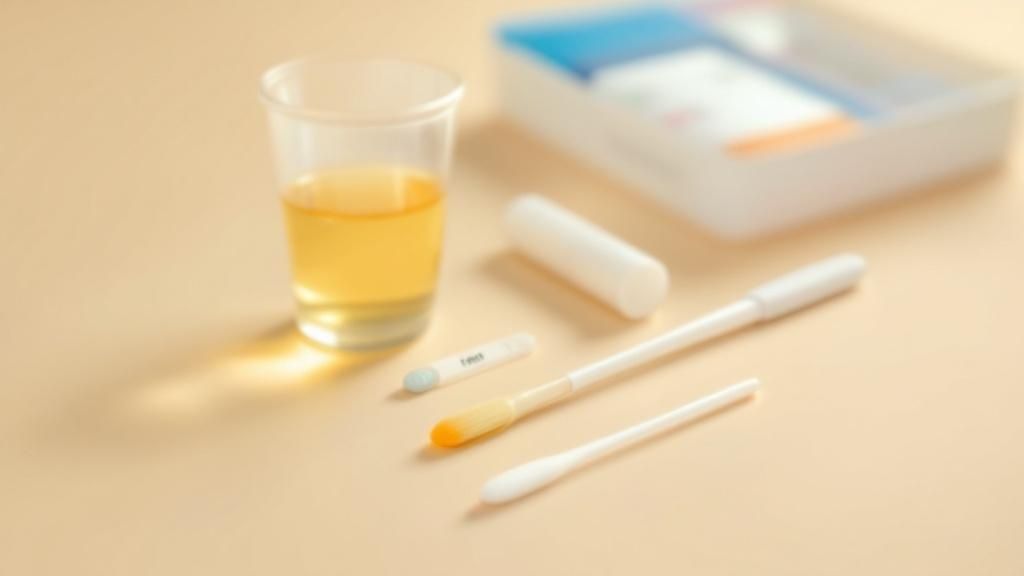
Workplace drug testing is undergoing a quiet but significant shift. For decades, the standard urine cup was the undisputed ruler of pre-employment screenings and random workplace panels. Today, oral fluid testing has emerged as a major alternative, adopted by private employers, federal agencies, and roadside screening programs alike.
While both methods screen for cannabis, they measure fundamentally different biological markers and answer completely different questions about consumption. Understanding the distinct detection windows of saliva and urine tests comes down to how the human body processes cannabinoids and how long those traces linger in different biological fluids.
What Each Test Actually Measures
To understand why the detection timelines diverge so sharply, you have to look at what the lab technicians are searching for under the microscope.
Oral Fluid Testing: Parent THC and Recent Ingestion
Saliva tests primarily detect parent delta-9-tetrahydrocannabinol (THC), the primary psychoactive compound in cannabis. When someone smokes, vapes, or consumes cannabis orally, residual THC coats the oral cavity, adhering to the mucosal membranes, gums, and teeth.
While a tiny fraction of THC can pass from the bloodstream back into salivary glands, the overwhelming majority of THC identified in an oral swab comes directly from this local surface contamination. Because parent THC clears from the mouth relatively quickly as saliva replenishes, an oral swab functions essentially as a snapshot of recent intake rather than a historical ledger of lifestyle habits.
Urine Testing: Inactive Metabolites and Fat Storage
Urine testing does not measure active delta-9-THC. Instead, it screens for 11-nor-9-carboxy-THC (THC-COOH), an inactive secondary metabolite created when the liver breaks down THC.
Cannabinoids are lipophilic, meaning they dissolve readily in fats. When THC enters the body, fatty tissues throughout the internal organs absorb it like a sponge. Over days and weeks, these fat stores gradually release the stored compounds back into the bloodstream, where the liver processes them into water-soluble metabolites for the kidneys to filter into urine. This slow, steady elimination process explains why urine panels reveal cannabis long after any active effects have dissolved.
Detection Windows Compared: How Long Does Cannabis Stay Detectable?
The difference between oral fluid and urine detection is best understood as a contrast between hours and weeks.
The Saliva Detection Window: Hours to Days
Oral fluid screenings feature a tight detection window designed to pinpoint recent use.
- Occasional consumers (once or twice a month): THC typically drops below standard cutoff levels within 12 to 24 hours. In many cases involving minimal inhalation, detection levels drop significantly in as little as 6 to 12 hours.
- Moderate to regular consumers (several times a week): Oral fluid detection usually spans 24 to 48 hours.
- Chronic, daily consumers: Heavy, continuous cannabis consumption can extend the window to 48 to 72 hours. In rare instances involving extreme consumption of concentrated extracts, traces can persist slightly past 72 hours, but positive results beyond four days are virtually nonexistent in standard commercial testing.
Because oral fluid detects active compounds within a limited timeframe, many safety-sensitive industries view it as a much closer proxy for potential impairment than urine analysis.
The Urine Detection Window: Days to Weeks
Urine testing casts a wide historical net. Because THC-COOH releases slowly from body fat, the detection window expands significantly as consumption frequency increases.
- Single-use or infrequent consumers: A single joint or edible generally remains detectable in urine for 1 to 3 days.
- Moderate consumers (two to four times per week): THC metabolites typically clear within 5 to 7 days.
- Frequent consumers (daily or near-daily): Metabolites accumulate continuously in adipose tissue, keeping urine screens positive for 10 to 15 days.
- Chronic, long-term consumers: For individuals who consume multiple times daily for months or years, urine screens can remain positive for 30 days or longer. In documented clinical cases involving heavy consumers with higher percentages of body fat, inactive metabolites have shown up on sensitive panels for upwards of 45 to 60 days after complete cessation.
Key Factors That Alter Detection Timelines
These baseline windows are not universal guarantees. Individual biological and behavioral variables heavily influence how quickly someone clears either test.
Consumption Method
The route of administration dramatically affects saliva tests. Inhaled cannabis (joints, pipes, bongs, dry herb vapes) deposits high concentrations of sticky THC resin directly onto the tissues of the mouth, creating an immediate, strong presence on an oral swab. In contrast, swallowing a gel capsule or consuming an infused beverage may leave considerably less residual THC in oral cavity tissue, sometimes yielding a narrower saliva detection window. Urine testing, however, remains largely indifferent to the consumption method; once THC enters the bloodstream and metabolizes, it ends up in the urine regardless of how it was ingested.
Frequency, Potency, and Cumulative Load
A single session involving high-potency cannabis concentrates (such as dabs, live resins, or concentrates testing above 70% THC) floods the body with far more milligrams of cannabinoids than a mild, low-potency flower. For urine testing, cumulative exposure is the primary variable: repeated dosing continually replenishes the body’s fat stores, compounding the clearance timeline exponentially.
Body Composition and Metabolic Rate
Because urine tests depend on fat-stored metabolites, an individual’s basal metabolic rate, physical activity, and body mass index (BMI) play a major role in clearance. Individuals with faster metabolic rates and lower percentages of body fat generally clear THC metabolites from urine faster than sedentary individuals with higher adipose tissue reserves. Saliva clearance is far less dependent on body fat percentages and is driven primarily by oral hygiene, salivation rate, and direct oral clearance.
Laboratory Cutoff Levels
A test result is only as broad as the laboratory’s established threshold. Commercial tests do not look for absolute zero; they flag samples that meet or exceed a specific cutoff concentration.
For urine, the standard initial immunoassay screening cutoff established by federal workplace standards is 50 ng/mL, with confirmatory testing at 15 ng/mL. For oral fluid, the initial screening threshold is typically set around 4 ng/mL, with confirmation testing dropping to 2 ng/mL. Adjusting these cutoffs higher or lower directly expands or contracts the theoretical detection window.
Why Employers and Testing Authorities Choose Between Them
The operational advantages and philosophical goals of each test determine which method an organization chooses.
Advantages of Oral Fluid Screening
Employers are increasingly adopting oral fluid swabs because collections are directly observable. The test administrator watches the donor place the collection stick between their cheek and gum, virtually eliminating the risk of adulteration, dilution, or sample swapping—tactics commonly attempted with unobserved bathroom urine collections.
Furthermore, saliva swabs do not penalize employees for legal, off-duty weekend consumption when testing takes place late in the workweek. For post-accident investigations and reasonable-suspicion protocols, saliva provides immediate evidence of whether cannabis was consumed within the preceding 24 to 48 hours.
Advantages of Urine Screening
Urine remains the standard choice for pre-employment screening programs that deliberately aim to evaluate an applicant’s broad lifestyle habits. It offers a standardized, long-established testing infrastructure with clear legal precedents and low cost per panel. Employers with zero-tolerance policies who want to identify any cannabis consumption over the preceding month continue to rely on urine as the gold standard.
Choosing Context Over Assumptions
Evaluating the risk or outcome of a cannabis screen requires understanding which biological fluid is under review. A person who consumed cannabis three days ago would almost certainly test negative on an oral fluid swab, yet that same individual could easily test positive on a standard urine panel for weeks to come.
While urine testing looks deep into the past to confirm whether an individual uses cannabis as a habit, saliva testing looks directly at the immediate rearview mirror to identify recent exposure. Understanding that fundamental distinction removes the guesswork from how testing windows work in the real world.
Meta Title: Saliva vs. Urine Drug Tests: Cannabis Detection Windows Explained
Meta Description: Learn how cannabis detection windows differ between saliva and urine drug tests, what each screening measures, and why detection timelines vary from hours to weeks.